
As sustainability moves from a marketing trend to a regulatory and operational necessity, businesses across India and globally are rethinking their packaging choices. Two terms frequently appear in this transition: compostable bags and biodegradable bags.
While they are often used interchangeably, they are not the same — and the difference matters.
For commercial businesses, hospitality brands, hospitals, retail stores, waste management providers, and food service operators, understanding the distinction is essential not only for environmental responsibility but also for regulatory compliance and long-term brand positioning.
This guide explains the difference in depth — from material composition and certifications to environmental impact and business implications.
What Are Biodegradable Bags?
Biodegradable bags are materials designed to break down over time through natural processes involving microorganisms such as bacteria and fungi. In theory, they decompose into smaller components when exposed to environmental conditions.
However, the term “biodegradable” is broad and often misunderstood.
It does not automatically specify:
- The timeframe for decomposition
- The environmental conditions required
- Whether the material leaves toxic residue
- Whether it breaks down completely into natural elements
Some biodegradable plastics are made using conventional polymers blended with additives that accelerate fragmentation. In certain cases, this can result in smaller plastic particles rather than full biological assimilation.
The Key Limitation
A biodegradable product may degrade eventually — but “eventually” could mean years. Without controlled composting conditions, some biodegradable plastics persist in landfills or open environments longer than expected.
This ambiguity is why regulatory bodies increasingly emphasize certification and clarity in labeling.
What Are Compostable Bags?
Compostable bags are a specialized category within biodegradable materials. They are engineered to break down completely into non-toxic natural elements under composting conditions.
Unlike general biodegradable materials, compostable bags must meet strict decomposition criteria within a defined timeframe.
Certified compostable bags:
- Decompose into water, carbon dioxide, and biomass
- Leave no harmful residue
- Do not generate microplastics
- Contribute to soil health under proper composting conditions
At G2G Bags, we manufacture CPCB-certified compostable packaging solutions using cornstarch-based biopolymers and advanced blends of PLA (Polylactic Acid), PBAT (Polybutylene Adipate Terephthalate), and cellulose fillers. These materials are engineered to ensure durability, strength, and reliability across commercial, retail, hospitality, medical, and household applications — while maintaining certified compostability standards.
This balance between performance and environmental safety is what distinguishes true compostable packaging from loosely labeled biodegradable products.
Compostable vs Biodegradable Bags: A Side-by-Side Comparison
| Feature | Compostable Bags | Biodegradable Bags |
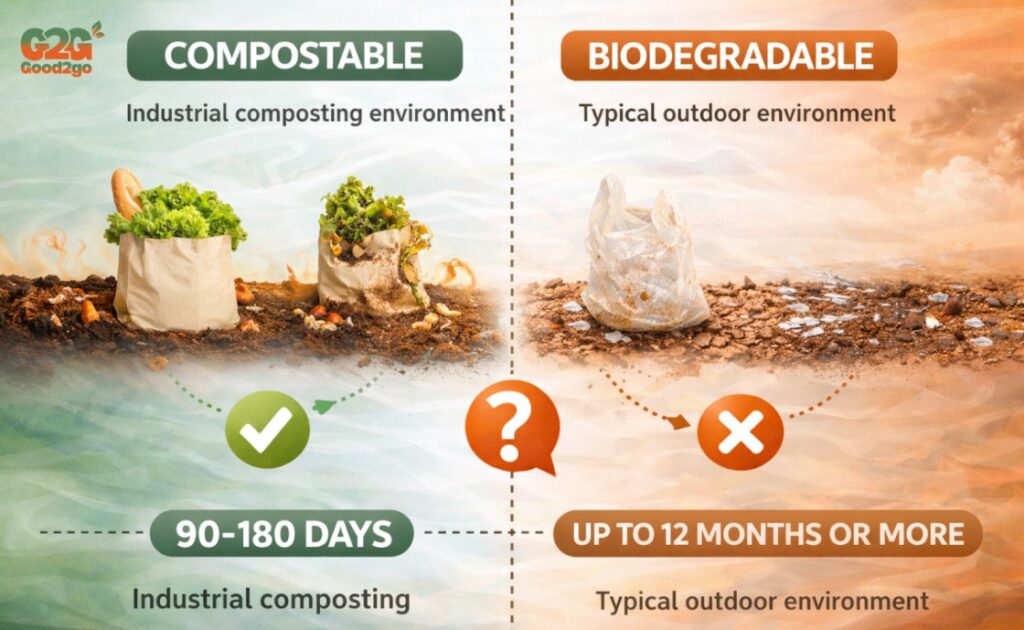
| Decomposition Timeline | Typically 90–180 days (under certified composting conditions) | Varies widely (months to years) |
| Certification Requirement | Mandatory for credibility | Often optional |
| Toxic Residue | None (when certified | May leave residue |
| Microplastic Risk | No | Possible |
| Compost Benefit | Yes | Not necessarily |
| Regulatory Clarity | High | Often ambiguous |
All compostable bags are biodegradable — but not all biodegradable bags are compostable.
This distinction becomes critical in regulated markets such as India.
Environmental Impact: Which Is Truly Sustainable?
1. Landfill Conditions
Landfills are oxygen-limited environments. Without oxygen and microbial balance, many materials — even biodegradable ones — break down very slowly.
Certified compostable bags are designed for industrial composting facilities where temperature, humidity, and microbial activity are controlled. Under these conditions, decomposition is predictable and complete.
Compostable materials are designed to break down completely under composting conditions. To understand this process in detail, read our guide on how compostable bags break down.
2. Microplastic Concerns
Some biodegradable plastics fragment instead of fully decomposing. Fragmentation can contribute to microplastic pollution, which poses long-term environmental risks.
Certified compostable materials, by contrast, are required to disintegrate completely without toxic remnants.
3. Soil Health Contribution
When composted properly, certified compostable bags convert into organic matter that can enhance soil structure rather than contaminate it.
For waste management services, municipalities, and environmentally conscious commercial establishments, this distinction has real sustainability implications.
Understanding the environmental impact of compostable vs plastic bags helps businesses choose packaging that minimizes pollution.
Certifications That Matter — Especially in India
Certification is where the difference becomes legally significant. In India, manufacturers must comply with strict regulations including compostable bag certification in India issued under CPCB guidelines.
Globally recognized compostability standards include:
- EN 13432
- ASTM D6400
- ISO 17088
G2G Bags holds CPCB certification for its compostable packaging solutions, ensuring compliance with Indian Plastic Waste Management Rules. This certification verifies that our products meet stringent decomposition, toxicity, and disintegration requirements under approved testing standards.
For businesses operating in retail, healthcare, hospitality, food services, or large-scale commercial sectors, choosing CPCB-certified compostable packaging reduces regulatory risk and ensures alignment with environmental mandates.
Internationally, certification alignment also supports export compliance and sustainability positioning beyond India.
Materials: What Makes Compostable Bags Reliable?
One common misconception is that eco-friendly means fragile.
Modern compostable bags are engineered for strength.
Our compostable packaging solutions are manufactured using:
- Cornstarch-based biopolymers
- PLA (plant-based polymer derived from renewable resources)
- PBAT (flexible compostable polymer)
- Cellulose fillers for enhanced structural integrity
This combination allows compostable bags to maintain:
- Load-bearing strength
- Tear resistance
- Moisture handling capability
- Functional durability across industries
From supermarkets and grocery outlets to hospitals, restaurants, pharmacies, clothing stores, events, and waste management services — compostable packaging must perform before it decomposes.
Engineering matters as much as sustainability.
Cost Comparison: Are Compostable Bags More Expensive?
In most markets, compostable bags carry a higher upfront manufacturing cost than conventional plastic.
However, cost evaluation should consider broader business impact:
- Compliance with plastic bans and regulations
- Avoidance of penalties
- Improved brand perception
- Growing consumer preference for sustainable brands
- Alignment with ESG commitments
For commercial businesses, hospitality chains, healthcare facilities, retail stores, supermarkets, and food service operators, compostable packaging often represents a strategic long-term investment rather than a short-term expense.
As global sustainability standards tighten, early adoption reduces future transition costs. Businesses looking to transition can explore different thickness and strength options within our compostable packaging portfolio based on their operational requirements.
Which Option Is Better for Businesses?
The right choice depends on the regulatory environment, brand positioning, and operational goals.
For businesses operating in India and international markets where sustainability compliance is tightening, certified compostable bags generally offer:
- Clear regulatory alignment
- Defined decomposition standards
- Reduced legal uncertainty
- Stronger sustainability messaging
Industries such as:
- Commercial enterprises
- Waste management services
- Hospitality and events
- Hospitals and healthcare facilities
- Restaurants, cafés, bars, and hotels
- Retail stores and supermarkets
- Grocery outlets and food markets
- Pharmacies and healthcare providers
- General merchandise and department stores
benefit from predictable compliance and credible environmental positioning.
For example, supermarkets and grocery outlets often require durable compostable retail carry bags, while hospitals and waste management services rely on heavy-duty compostable garbage bags that meet compliance standards.
Biodegradable products without recognized certification may introduce ambiguity — both legally and environmentally.
Frequently Asked Questions
Do biodegradable bags break down in landfills?
Not reliably. Landfill environments lack oxygen, slowing natural decomposition processes significantly.
Can compostable bags be recycled?
No. Compostable bags should not enter plastic recycling streams. They are designed for composting systems.
Are compostable bags waterproof?
Yes. Compostable materials are engineered to maintain durability during use while breaking down under composting conditions.
How long do compostable bags take to decompose?
Under certified industrial composting conditions, most compostable bags break down within 90–180 days.
Is CPCB certification important in India?
Yes. CPCB certification ensures compostable plastic products meet defined environmental safety standards under Indian regulations.
Final Verdict: Compostable vs Biodegradable
While both terms suggest environmental responsibility, compostable bags provide greater clarity, stricter certification, and more reliable ecological outcomes.
For businesses operating in regulated markets like India — and for brands expanding internationally — certified compostable packaging offers stronger compliance assurance and more credible sustainability positioning.
Retail stores and supermarkets are increasingly switching to compostable carry bags as a sustainable alternative to conventional plastic shopping bags.
As environmental policies evolve and consumer awareness grows, the distinction between loosely defined biodegradable products and certified compostable solutions will continue to matter.
Choosing correctly today protects both the environment and your business tomorrow.